Could you introduce yourself and your artistry?
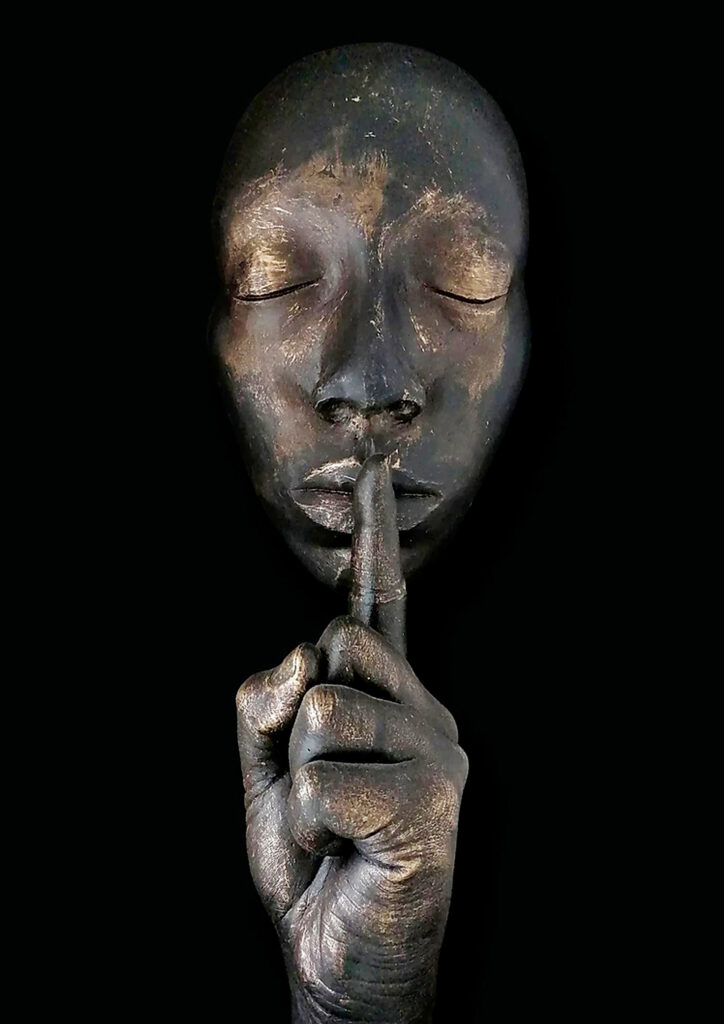
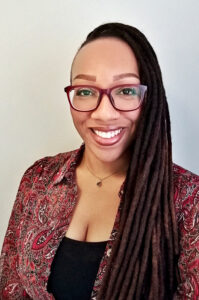
I am a multidisciplinary artist and educator based in London. I studied at London Guildhall University and embarked on a career in architecture, interiors, and textile design for 13 years before leaving the design industry to focus on developing my own art practice. I work across a variety of media employing both traditional and experimental techniques in my creative process. With a focus on painting and sculpture, my work explores my ancestry and identity through the use of symbolism, abstract imagery, and portraiture. I am inspired by African symbolism, spirituality and storytelling, and aim to share their rich narratives through contemporary visual interpretation.
I am a qualified university lecturer and Associate Fellow of the Higher Education Academy. I work and tutor private art students from my studio in southeast London.
My work sets out to interrogate and dissect the many aspects of my own existence, including my ancestry, emotions, mental health, self acceptance, identity, and healing. Often working in a variety of different mediums, I employ the same methodology across all my creative projects and work with the principle that the spirit, energy, and inspiration of the subject determine the materials and form of the piece.
Each project often consists of multiple works, explored and experimented with in a range of different media, grouped around specific themes and meanings. During my process of research and production I often come across new areas of interest which in turn, lead to new bodies of work.
I am a strong advocate of art as a form of creative therapy and strongly believe that engaging in art, whether in a creative capacity or a voyeuristic role, has a beneficial effect on mental health and personal wellbeing.
What role does the Black artist have in society?
Our role is varied. There’s no specific job description pertaining to being a black artist, yet we somehow manage to take on several responsibilities – we represent a marginalised group so we have to take care not to have our work clumped together in one homogeneous group or be seen as a monolith. I believe that by our very existence, we are here to tell alternative narratives and give insight into the creative minds of black people. We represent different stories and experiences that may otherwise be omitted from the mainstream arts and culture scene.
How can we grow and empower the Black art community?
The best way to grow and empower the black art community is to support black artists. Buy art from black artists. Promote black artists. Send opportunities to black artists. Create spaces for black artists. It all starts with us – it doesn’t take a lot to support your favourite artist – sharing their work is a great (and free) way to do it. Ideally we should all be working together as well. We should be collaborating with each other, learning from each other and raising each other up. There’s no place for the ‘crabs in a barrel’ mentality – when one wins, we all should win.
Do you feel that your art community challenges existing barriers and assumptions?
The UK black art community is relatively small compared to the U.S. but there are so many of us who are already making moves to challenge the status quo here. We have artists who now have their work being recognised and placed in English Heritage buildings and museums, spaces which previously we were not really seen in. I feel we are definitely moving away from what society deems as typically ‘black art’. We are creating work that reflects our own lived experiences and being unapologetic about it.
What types of art and culture do you like to consume?
I love sculpture in all it’s various forms. I went to art school so I was fortunate to have had the opportunity to learn about lots of different sculptors. I am particularly interested in female sculptors as their work has undergone different challenges compared to male sculptors. I love work that explores natural forms and femininity. Whilst studying I was a big fan of Barbara Hepworth’s work. As I’ve explored more, I’ve come across more black female sculptors. I love the story behind Augusta Savage’s career and I’m currently a big fan of Simone Yvette Lee.
How do you work and how has your practice changed over time?
I work completely opposite to the way I was taught at school. I was taught to always start with small ideas and study sketches and develop my ideas from there – something I never did and I think my art teacher gave up trying to get me to work that way. I usually see the final piece in my head and work backwards from that. I tend to just jump straight in with something and correct my mistakes as I go along. Is this the right way to work? Probably not, but it works for me! Once I get into the swing of things, I’m pretty organised and efficient with how I work, so I don’t see myself changing the way I do things.
How do you define success as an artist?
Success if subjective. If I create what I think is an amazing piece of work and the only people who give it any recognition are my children, then that is success. I have had work acquired by museums, exhibited in amazing spaces and sold original pieces to collectors – all ‘successful’ achievements. But I have also had my paintings recreated by 9 year olds across an academy of 3 primary schools in London last year, with the children studying me and my work for Black History month. Seeing their faces with their versions of my painting was absolutely amazing! Knowing that there were children in primary school seeing images I never had the chance to see at that age and learning about black artists is, for me, one of my biggest successes. I want the next generations to see us and feel represented and inspired by what we do as artists.
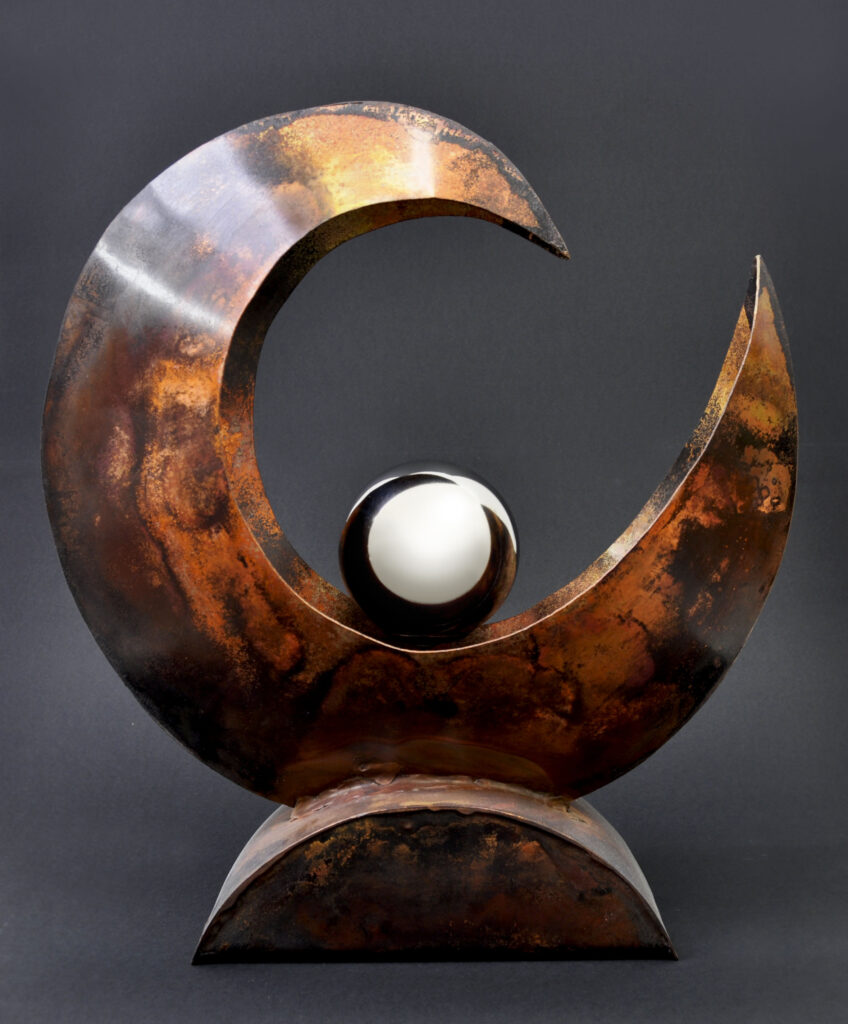
Merissa Hylton, Sankofa, 2020, Copper and stainless steel
How do you cultivate your audience?
I’m quite an open person by nature and I think that is one of the things people are drawn to. I tend to remove the ‘mystique’ around being an artist and show people my whole process – including all the fails. I think that taking people on the creative journey with me gives them a sense of being a part of the process. Many people offer advice and words of encouragement and I appreciate it a lot. I’m inspired by the diversity of my audience as much as they’re inspired by my work.
What is integral to the work of an artist?
Rest! Physical rest, mental rest – just rest! A lot of artists’ minds are on the go 24/7 – it’s not something we can always control. We constantly have ideas buzzing around in our heads and we find ourselves doing everything or nothing at all. I’ve learned that rest is essential to prevent myself burning out or coming up against a creative block. Sometimes that creative block is your body shouting out at you to rest – it’s not something that should be ignored.
How does art-making impact other parts of your life?
It’s therapy for me. As an artist, sometimes my mind never stops, so creating art is my way of getting some of my thoughts out of my head and making space of a bit of calm. I’m happy when I’m creating and I’m fortunate to be able to make a living from it. I love that my children have grown up around me and my art work and they understand the joy it brings me.
How have you developed your career?
I’m a multidisciplinary artist so I’ve always made an effort to try different things and learn different techniques. It’s always been important to me to make sure my practice grows and develops and because my mind is constantly thinking of new ideas, I never really stop learning. Moving into my dedicated art studio has been pivotal in my artistic development as it’s allowed me to have more space to explore my ideas. It’s also within a large mixed art community so there are always opportunities to learn, train and collaborate with other artists and creatives.