How did you get into printmaking? How has your practice changed over time?
My introduction to printmaking was during my studies at Pratt. I went to art school to become a painter. I took a printmaking class as an elective and I really struggled with it. I took lithography which is very technical and I didn’t love the process. It felt rigid and scientific. At that time, I preferred a process that was more immediate and playful. Not long after graduating college I experimented with monotypes. This technique is very fluid and fast. I loved the immediacy of making monotypes, the technical part didn’t get in the way and I was able to make deep rich color combinations that I found exciting! I worked solely making abstract monotypes composed of washes of colors for years.
In 2019, I got a printmaking fellowship at the Robert Blackburn Workshop and that changed everything. The fellowship introduced me to a number of different printmaking techniques that I had never tried. The fellowship expanded my printmaking vocabulary. I began to really think about my work differently. I felt like I now had the tools to really say something with my art, so many options to express myself. It also opened up the idea of working with master printmakers. Master printmakers are called masters for a reason, they deal with the technical aspects which frees the artist up to be creative. I love the collaboration.
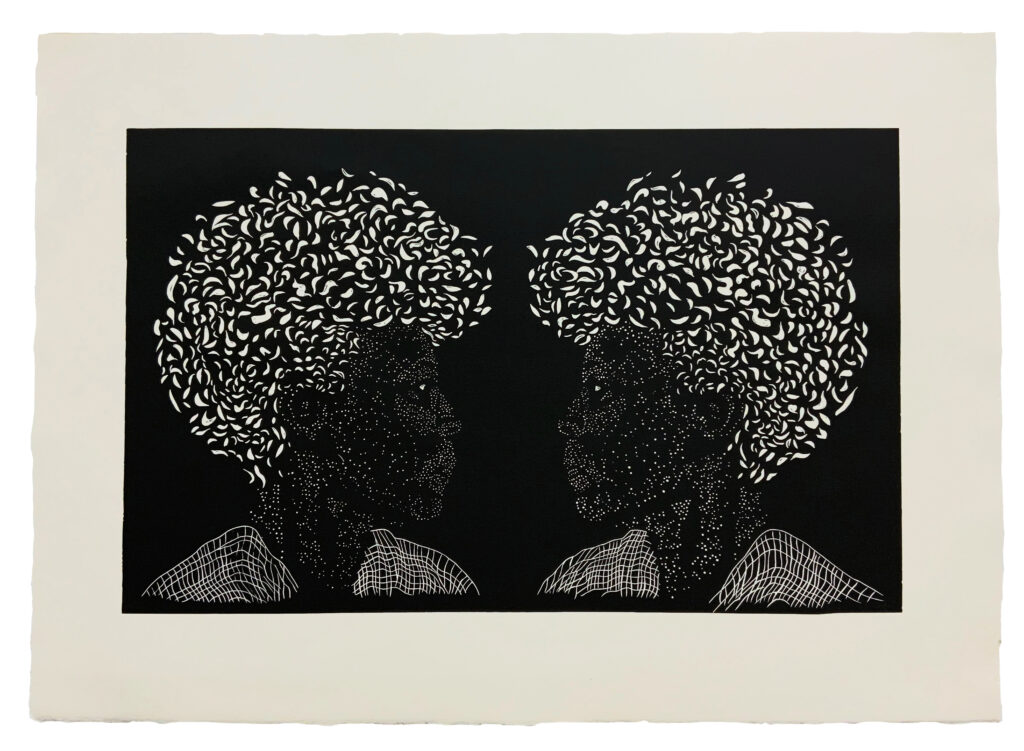
Karen Revis, Sankofa Self Portrait, 2021, Linocut
This issue’s theme is Abstraction of Expression. Can you tell us about your abstract work? What impact does abstraction have on the way your messages are interpreted?
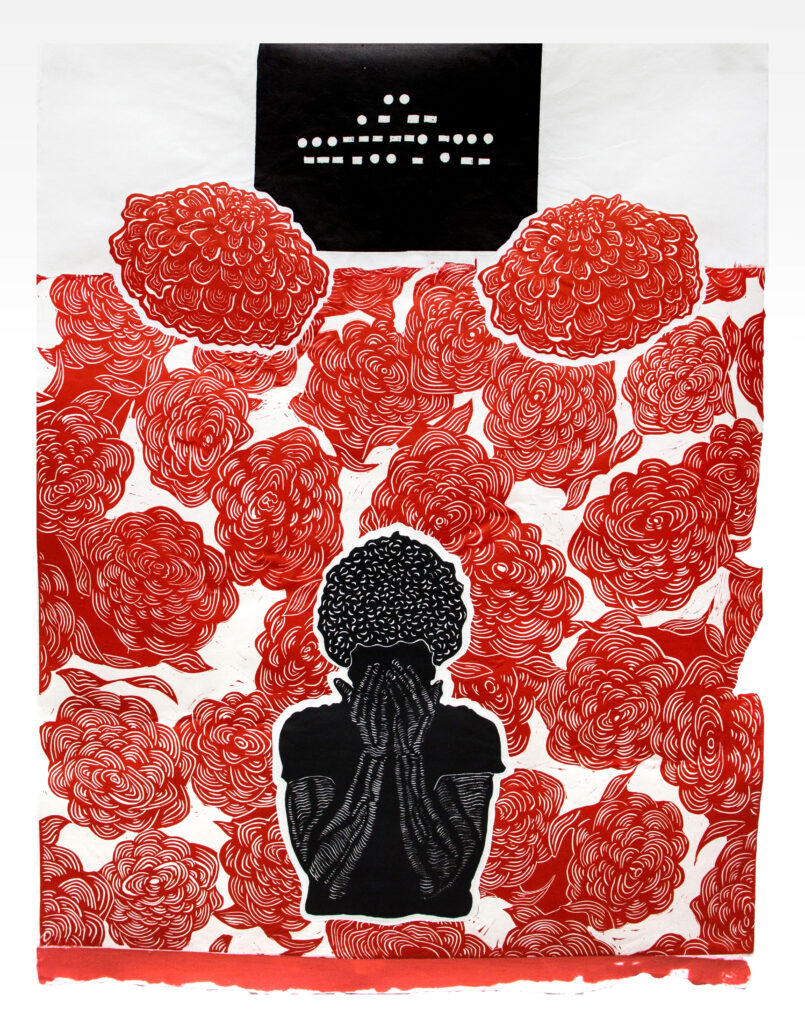
For me abstraction is a broad term. Even though my work contains figurative elements, black men and women, hands, cotton, etc., they are stylized and abstracted version of themselves. These figurative elements are collaged with abstract elements of marks, texture and color. I often create backgrounds with repetitive patterns that are sometimes symbols which tell the story of the work. Because of the abstract nature of my work, it lends itself to different interpretations.
You make art that addresses the Black history. What impact does art of this subject have? What have you seen come out of Black art?
“A picture is worth a thousand words”. Emotions can be communicated in such an honest way through art. Individual expressions of the human condition will always find an audience that relates because we are all connected. My art is a celebration of my culture and family. The themes in my work touch on Black pop culture and Black history. I use my art to tell my story my way and the beauty of art is that it’s accessible to everyone, regardless of age, race, faith or economic status. I have had the honor to present my work in various academic settings, from universities to grade schools, and the conversations have all been lively and thought-provoking. Teachers recognize art is an effective teaching tool. Art is so immediate and, believe it or not, you don’t need a particular skill to understand it. The artist’s message can be related even if you don’t like the artwork. I can honestly say I have never met a person who didn’t like art.
Through BAM we hope to inspire the next generation of creative entrepreneurs to tackle challenges we face as a community. What do you feel is missing within our Black art communities? What should the next generation work towards establishing?
I would love to see more diversity within competitive art residences and in academia. I would love to see young Black art students have the opportunity to express themselves in a way that is authentically Black and original without the approval or validation of a European influenced audience. Buying art and visiting galleries and museums in this country has historically been something for the elite. I can see this changing, but I want us to see that art which celebrates our culture and tells the story of our history is valued especially when it’s art by us and for us. We must understand that collecting the art of Black artists is an investment in ourselves and our legacy.
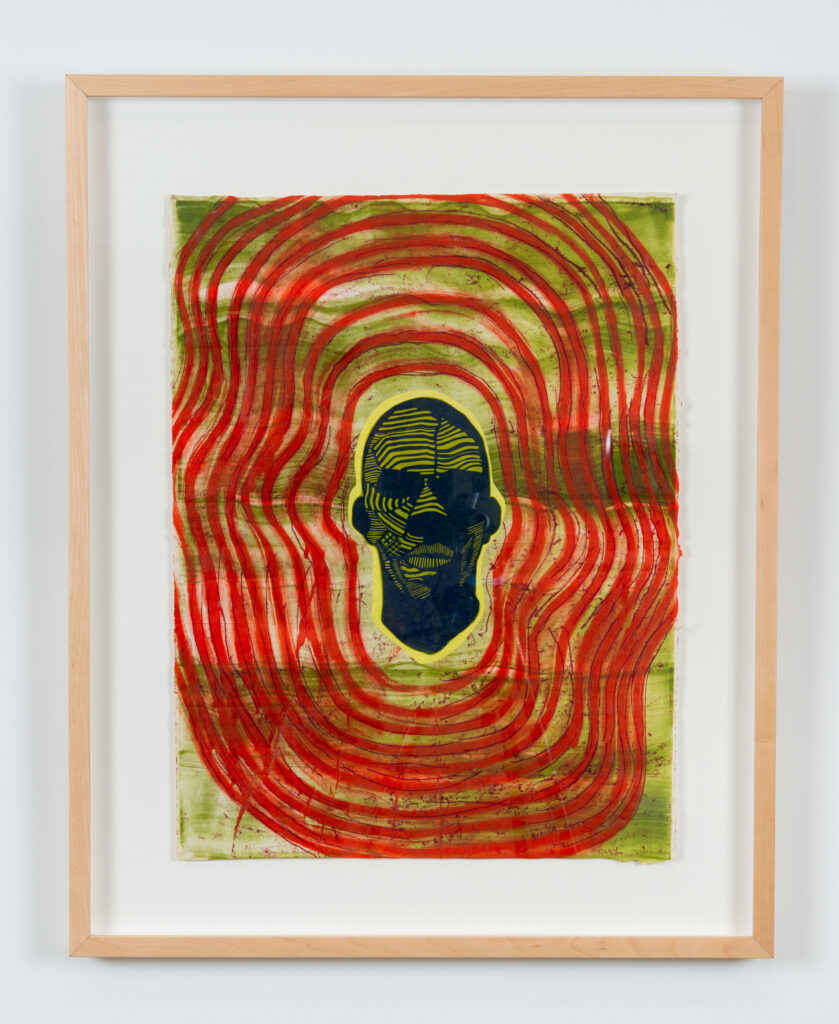
Karen Revis, Blue Face Orange Circles, 2020, Mixed Media on handmade paper
How do you seek out opportunities? How have you developed your career?
I’ve been an artist for more than 30 years and it’s been challenging. No one in my family before me pursued a career as a fine artist and it’s a strange career path because you can get a degree (and pay handsomely for it) and then find yourself on the street with a degree and there’s no clear path to take. Going to an art school did give me exposure to resources that help develop an art career. Even now, I spend a lot of time researching and applying for residencies, grants and fellowships that provide time, space and funding to create. I use a variety of resources like the New York Foundation for the Arts (NYFA) which provide a list of ongoing opportunities for artists. This is a tool every artist should be aware of and take advantage of. For years I thought the only sign of being a successful artist was to have a gallery. Galleries can be very difficult to get into and finding the right gallery /artist relationship can be challenging. However, I have found becoming a member of a collective can be very rewarding. Finding a community of artists is important and social media has made it much easier to connect to other artists, buyers and institutions interested in promoting art.
What types of art and culture do you like to consume? Who/what are your most important artistic influences?
My influences change depending on what I am interested in at the time and I often find inspiration in the most unlikely places. I recently saw “Inspiring Walt Disney: The Animation of French Decorative Arts” at the Metropolitan Museum and it blew me away. I realized my color palate is influenced by Disney. Right now, I am heavily into all things hip hop. I’m listening to rap and old school R&B in my studio. I’m also a big fan of Revolt TV mainly Drinking with Champs. I make a lot of work listing to Nori!
How do you define success as an artist? What do you wish to accomplish?
Being a professional artist means you are a small business owner. If you enjoy making art and pursue it as hobby that great! If making art is something you’d like to do for a living you have to make enough money to sustain your practice and your lifestyle. A successful artist is an artist who makes money! My goal is to be a practicing artist for as long as I desire. I would also like to bring a new audience to the art game. I’d like to inspire new Black art collectors and I’d like to show young black artists who are passionate that it’s possible to make art a career.
What are you besides an artist?
In addition to making art I also work with adult artists with learning disabilities. I lost my job, two years ago when Covid hit, and I am just going back now. I love working with these artists and I am constantly being pushed to be as authentic as they are.
What’s the best piece of advice you’ve been given?
I 100% believe in a quote by Colin Powell: “There are no secrets to success. It is the result of preparation, hard work, and learning from failure.”
The advice no one told me that I would give a artist starting out: Understand being a professional artist means you are running a small business so acquire the skills that it take to run a business successfully.